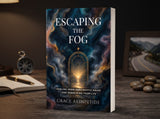
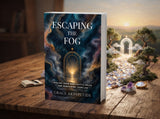
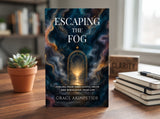
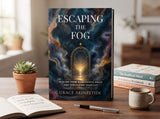
Escaping the Fog: Healing from Narcissistic Abuse and Rebuilding Your Life
Find your way forward with Escaping the Fog by author Grace Akinpetide, a compassionate guide to healing from narcissistic abuse, rebuilding your life, and reclaiming your freedom.
Available on Amazon
Buy the Ebook Buy the Paperback Buy the Hardcover
You may also like: You Weren't Crazy · Breaking the Mirror. Read more: Escaping the Fog blog post.
Related Products
Recently viewed
I think the hardest part of leaving a toxic relationship isn't always the leaving itself. Sometimes it's what happens afterward, when you finally have space to breathe but your mind is still replaying everything. That is what made Escaping the Fog feel different to me. It doesn't pretend that walking away automatically makes all the confusing feelings disappear.
I really connected with the idea that you can know someone wasn't good for you and still miss them. I've seen how easy it is to question yourself when your feelings don't match what you know logically. One day you can feel completely certain about a decision, and the next, one memory can make you wonder if you were too harsh. The book helped put that conflict into words without making it sound like you're failing at healing.
The discussion about anger also stuck with me. I've always thought of anger as something you eventually need to get past, but I liked the idea of slowing down and asking what the emotion is actually trying to tell you. That made me think differently about resentment and the things we sometimes try to push down because they're uncomfortable.
I also appreciated the explanation of why your body can stay on alert even when your mind knows you're safe. That made the ups and downs of healing feel much more understandable to me.
What I took away from this book is that rebuilding yourself isn't about becoming someone new. It's about slowly finding the parts of yourself that got lost along the way. That message stayed with me after I finished reading, and I think it is exactly why this book could mean a lot to someone who is trying to find their footing again.
Escaping the Fog is a compassionate and thoughtful guide to what happens after you begin to recognize—or finally leave—a harmful relationship. I appreciated that author Grace Akinpetide doesn’t treat leaving as the end of the story. Instead, she explores the complicated process of healing, including grief, anger, resentment, lingering attachment, and the difficulty of trusting yourself again.
I especially connected with the discussion of how the body can remain on alert even after the mind understands that a relationship is over. That perspective helped me better understand why emotional recovery can feel so much less straightforward than simply deciding to move on. I also appreciated the book’s gentle discussion of anger and the reminder that difficult emotions can contain useful information rather than something to be ashamed of.
What stood out most to me was Akinpetide’s reassuring, conversational tone. I never felt lectured or rushed toward some artificial version of “closure.” Instead, the book offers patience, understanding, and practical encouragement for rebuilding a sense of identity and safety.
Narcissists exist everywhere: acting up on the bus, at the supermarket queue, at work or at social gatherings. It is usually just better to avoid them and save yourself the trouble. The worst is when the narcissist is your significant other, whether you knew it all along or just started to realize the situation you got yourself into. This book is for those who chose themselves and decided to leave, regardless if they already left or are yet to leave. The author talks about how weird it can feel, even after leaving and how intensely you will stumble back and forth in your mind, wondering if you did the right thing by leaving.
As a psychologist, but mostly as a human being with personal troublesome emotions, I think this book feels like a warm hug from a friend.
This is a great self-help book for those who really struggle with recovering from a bad breakup with someone who was, well, narcissistic and abusive. Reading a passage from this book that can accurately relate to you and convey your feelings is therapeutic in its own right, but there’s also some deeper analysis here that I haven’t heard anywhere else, such as how your body can remember how you tense up during a shift in energy from past relationships, and how that adaptation is a form of scarring in-and-of itself.
Escaping the Fog is full of great insight like that, it explains some esoteric concepts like trauma bonds in ways that are easy to understand but what I really like about this book is the prose; if you’re buying this book it’s likely because you’re looking for answers as well as some sort of comfort, and the way this book is written really makes it feel like it’s having a conversation WITH you rather than simply trying to convey information AT you if that makes sense, and it does it in a gentle, caring way so I really appreciate that comforting tone in regards to something as sensitive as this.
Helpful
Report
From other countries
This final entry in Grace Akinpetide's trilogy is a deeply compassionate and clinically insightful guide. Rather than focusing solely on identifying toxic dynamics, the narrative zeroes in on the complex aftermath of leaving, specifically addressing the unsettling quiet that often follows emotional turbulence. Akinpetide masterfully validates why peace can initially feel uncomfortable, reframing residual cravings as natural psychological recalibration rather than personal failure. Her writing strikes a delicate balance between gentle validation and clear, practical guidance for rebuilding autonomy. It provides an empowering roadmap for readers navigating the subtle, non-linear journey of emotional recovery, offering clarity without ever resorting to superficial platitudes. It is an invaluable resource for long-term personal restoration.